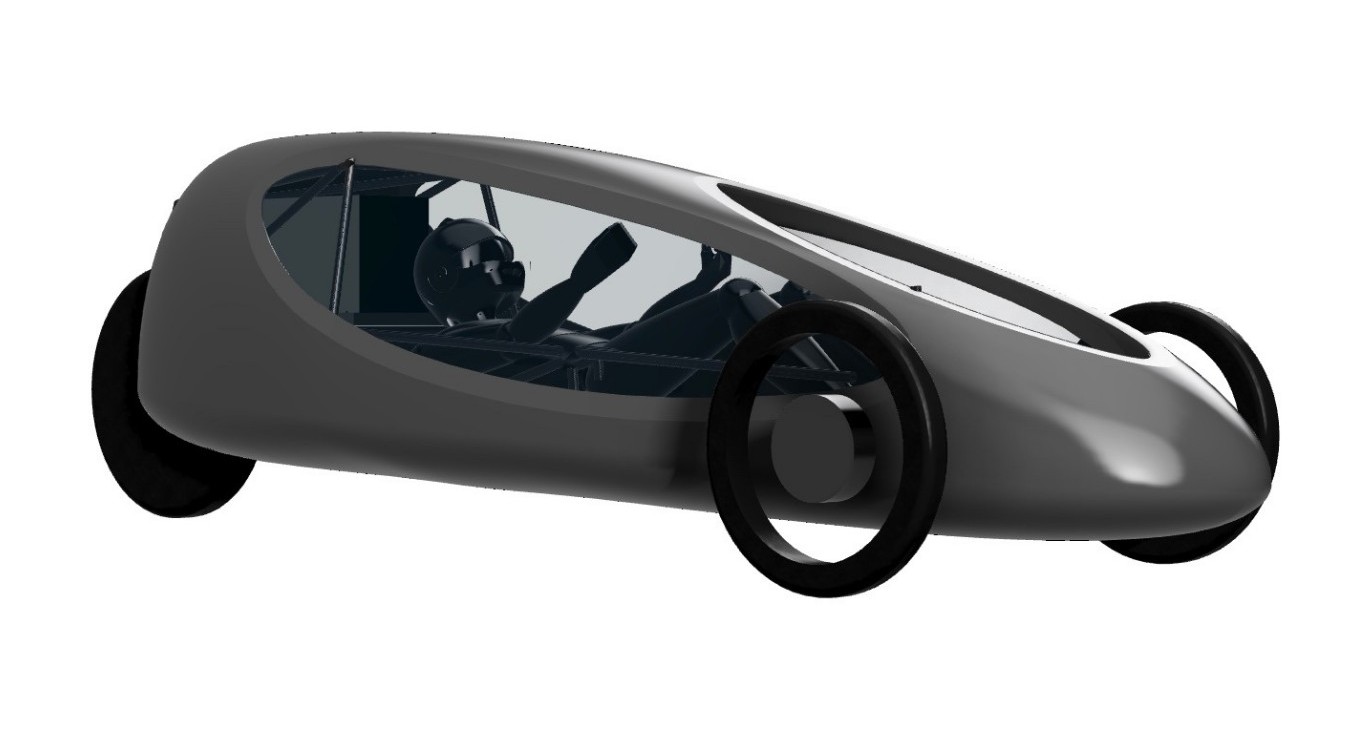
The HEV has been a core project for Hydrogen Fuel Racing since the society began. It is designed to reach the furthest distance it can on a single tank within a set time, competing in the Shell Eco-Marathon, an international competition built on the idea of innovative efficiency.
The vehicle is in development now, building towards its Shell Eco-Marathon debut.
The team designs the chassis with a primary focus on safety and structural integrity. We use FEA to validate the chassis under expected load conditions and design firewall separations for driver safety. The Chassis team is the backbone of the project and oversees component integration and fabrication.
The team uses computational fluid dynamics (CFD) to design the streamlined shape, reduce drag coefficient and optimise and control the airflow around our endurance vehicle. The aerodynamics team determine how far we will get with every atom of hydrogen spent.
The team focuses on designing both the sensing equipment and motor power systems of the vehicle. We refine technical designs, discovering more efficient ways to distribute power across the vehicle's systems.
Focused on control systems engineering and vehicle handling, from steering and braking to manoeuvrability. The Vehicle Dynamics team ensures the HEV not only handles well but dominates on track.
The Data & Telemetry team serve as race side engineers. They make the calls that ensure our endurance vehicle performs at its best, using the data they collect through telemetry.
The Hydrogen Fuel Cell team work with the chemical energy systems in the Shell Eco-Marathon vehicle. They work on P&ID diagrams and ensure hydrogen systems are kept secure, safe and well in regulation.